€27.00
Esaurito
In the mid-1970s, New York became the laboratory of the new wave. In the underground temple of CBGB’s, Patti Smith, the Ramones and Television set audiences ablaze with a new sound that laid the foundations for punk and perhaps changed rock music forever. Drawing inspiration from their decadent masters, the Velvet Underground, these New York pioneers grafted sonic gestures onto the classic song form, expressing the neuroses of a generation raised without the utopian ideals of the 1960s. Of this sublime triad, the last to release their debut were Television, led by Tom Verlaine — an otherworldly guitarist with a swan-like neck, fascinated by decadent poetry (as his pseudonym reveals), and with a past as a dockworker and bookstore clerk.
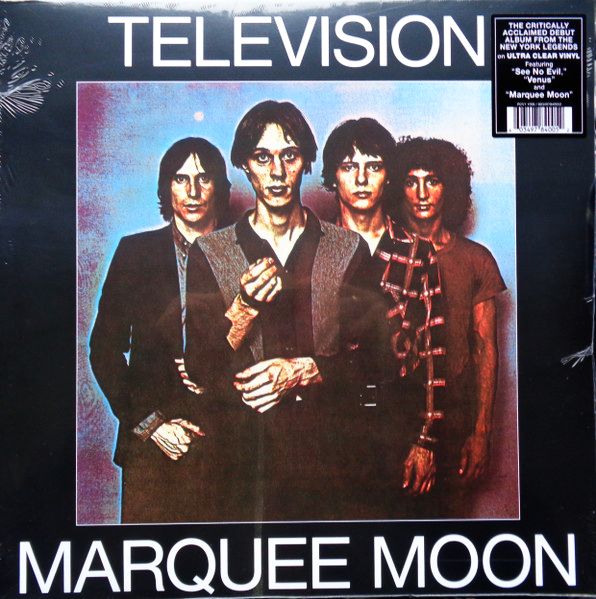
Preceded by the single “Little Johnny Jewel,” released on the independent Ork label, their debut album for Elektra arrived in 1977: Marquee Moon. An absolute masterpiece of the entire new wave movement, the record is a poignant reimagining of old underground psychedelia — a mosaic of dissonant accompaniments and disorienting solos, both built on the monotonous repetition of the same phrase and subtle variations in tone color. Above all, the songs are marked by Verlaine’s extraordinary guitar lines. Blues foundations, irresistible riffs rich in arpeggios, feedback, tremolo and glissando, and eccentric, vaguely jazz-inflected solos that even hint at Eastern influences effectively reinvent the use of the electric guitar in rock music, turning it into the band’s true “voice” — and doing so in the middle of the punk era, which had largely banished guitar solos.
Patti Smith, who shared both romantic and artistic ties with Television’s leader, once said of him: “The sound of Tom Verlaine’s guitar makes you think of the cry of a thousand birds.” Indeed, Verlaine’s guitar sounds acidic, piercing, estranging, matching the guttural tones of his hallucinated android-like singing.
Thus was born the awkward (and unforgettable) folk-rock of “Venus,” with its sharp guitar phrasing and bass line surrounded by seductive backing vocals, a delightful chorus, and percussive magic. Then there is the disjointed sweetness of the ballad “Elevation,” driven by a highly personal bass line intertwining with the guitar’s aching arpeggios, and the mechanical pulse of the icy “See No Evil.” These are flashes of vibrant, lyrical rock capable of conveying both jolts of neurosis and a sense of resigned desolation.
And then there are the two long jams, “Marquee Moon” and “Torn Curtain,” unsettling progressions into the darker, diseased corners of the human psyche. The title track, a marvelous “lunar” suite, unfolds as an extended sequence of circular art rock, dissolving into a hypnotic effect with progressive reminiscences. Above all, it is a chilling demonstration of what Verlaine’s guitar can achieve: unsettling and evocative (the famous “cry of a thousand birds” praised by Patti Smith), yet also obsessive and nerve-shredding, leading the listener down a winding, subtly cerebral path. “Torn Curtain” is an electric ride with blues cadences, an acidic serenade that alternates the tender support of organ and piano with the fury of the drums, portraying a long night that stretches inexorably across the world. The track also highlights the essential support of Fred Smith on bass and Billy Ficca on drums, both invaluable in the arrangements.
These are alienated, desolate jams, born of Coltrane’s free jazz and the psychedelia of the Grateful Dead, dragging themselves majestically through endless agonies. Verlaine’s strangled voice at times recalls Patti Smith’s, though it is even more tense and neurotic, while his singing can be considered a “sophisticated” variation of Lou Reed’s perverse spoken style.
Television’s otherworldly rock is simply the flip side of that urban desolation, that fear of the future told by Pere Ubu in Modern Dance and by bands such as Devo and Ultravox — a crucial step in the construction of a new musical genre, the new wave, which would prove one of the most fertile of the following decade. Marquee Moon won over critics worldwide but sold poorly in the United States. As John Rockwell wrote in Rolling Stone: “Television were too abrasive and anachronistic (almost like the Byrds with exposed nerves) to succeed.” Verlaine and his bandmates, however, would become hugely popular in England, significantly influencing the shift toward the more desolate forms of new wave embraced by Joy Division, Echo & The Bunnymen, The Cure, Siouxsie and the Banshees, and The Smiths. Their legacy would remain fundamental in the decades that followed, as demonstrated by bands such as Smog, Interpol, and many others.
Released on February 8, 1977. The band spent three weeks in November 1976 recording the album with Andy Johns at A&R Studios.
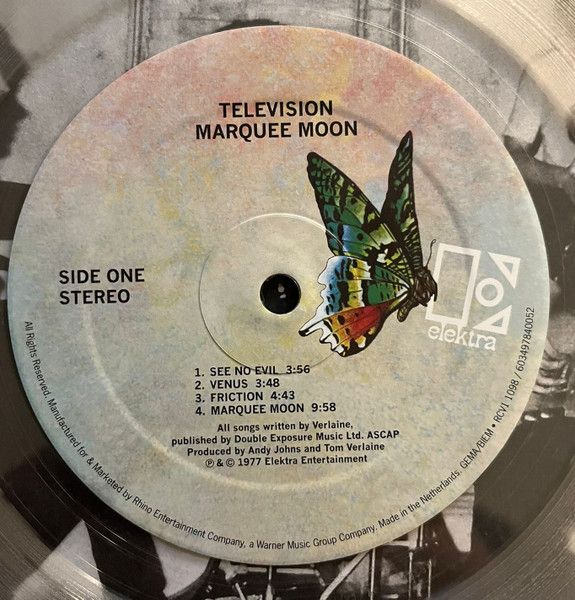
Elektra – RCV1 1098, Elektra – 603497840052
Vinile, LP, Album, 2022 Reissue, Ultra Clear